problem gambling treatment in New Jersey
we understand how bad it can get. we designed this to help you find your way back.
Problem gambling can affect much more than money. Our program brings clinical care and practical support together to help you rebuild trust, stability, and a life that feels like yours.

01
Problem gambling can feel impossible to manage. It can affect your thoughts, finances, relationships, work, and the people who care about you—often in silence.
We’re building a specialized team and a practical system of support so you do not have to figure out how to turn things around alone.
talk through the next step02
the national picture
Problem gambling statistics in the United States and the tri-state region
Millions of people are living with repeated warning signs. The impact can reach finances, relationships, work, and the people closest to them.
impact close to home
classified as high risk in a Rutgers report using data collected in 2021.
Rutgers reportclassified as present problem gamblers across two samples in Pennsylvania’s 2025 assessment.
Pennsylvania assessmentidentified as at risk in New York’s 2020 statewide adult survey.
OASAS surveySources use different dates, samples, methods, and definitions. NGAGE 3.0 is not a prevalence estimate or diagnosis. State findings are separate signals and should not be ranked against one another.
the hidden addiction
It rarely looks
like what people
expect.
Problem gambling can be difficult to recognize because there may be no obvious outward sign. It can remain hidden until financial, emotional, work, or relationship consequences surface.
You are not alone, and you are not beyond help.03
what to expect when treatment begins
your first steps,
made clear.
Your care begins with understanding what has been happening and what you need now. Together, we build a plan around your goals, clinical needs, and the practical steps that support recovery.
protect
access
add distance from the next bet
rebuild
life
strengthen the life around recovery
 your plan
you are here →
first step
confidential intake and safety review
We begin by listening, assessing immediate needs and risks, and understanding what has been happening in your life.
what this can include
- Clinical and psychiatric assessment
- Immediate safety planning
- Your goals, preferences, and practical needs
You remain involved in every decision. The sequence may change based on safety, clinical need, consent, and availability.
step 02 →
protecting access
optional technology reset
If you choose this support, the care team may help add blocking software such as Gamban on supported devices and plan for high-risk accounts, apps, and times.
what this can include
- Supported-device review
- Account and app access plan
- Family safeguards with your consent
Blocking software adds friction; it does not replace treatment or block every gambling opportunity.
step 03 →
protecting access
state-specific self-exclusion support
If you choose this support, the care team may help you review voluntary self-exclusion options and the separate steps required in each jurisdiction.
what this can include
- Reviewing available programs
- Preparing for registration
- Planning for access outside enrolled programs
Self-exclusion is voluntary and jurisdiction-specific. Crossing state lines may require more than one registration.
step 04 →
your clinical relationship
connection with a primary therapist
We connect you with a therapist experienced in problem gambling, taking your clinical needs and the therapeutic relationship into account.
what this can include
- Individualized treatment goals
- Collaborative goal setting
- A plan designed with your input
You would remain in control. The pace would be shaped around safety, clarity, and progress.
step 05 →
clinical support
therapy and coordinated psychiatric care
Your plan may combine gambling-focused individual or group therapy with psychiatric care when assessment shows it is appropriate.
what this can include
- Individual and group therapy
- Co-occurring mental-health care
- Medication management when appropriate
The mix is individualized; not every service is part of every plan.
step 06 →
financial stability
budget planning and qualified referrals
Financial pressure is addressed as part of recovery planning, with practical triage and referrals when specialized counseling is needed.
what this can include
- Budget triage and spending safeguards
- Referral options for debt or creditor guidance
- Coordination with qualified independent professionals
Financial services may involve independent professionals and separate eligibility requirements.
step 07 →
the people around you
family education and support
With your consent, partners or family members may be included to improve communication, safety, and support around recovery.
what this can include
- Family education
- Boundary and communication planning
- Therapy when clinically appropriate
Participation is guided by your consent, privacy, and clinical needs.
step 08 →
life around treatment
independent housing
When housing is part of the plan, care management may help coordinate options offered by independent organizations, subject to eligibility and availability.
what this can include
- Independent housing referrals
- Eligibility and availability review
- Coordination with outside providers
Housing is not provided by Eleve and is separate from treatment.
step 09 →
connection outside treatment
peer-support access and transportation planning
Care management may help identify GA or other peer-support meetings and coordinate transportation where resources are available.
what this can include
- GA or other peer-support options
- Meeting-access and transportation planning
- Connections that can continue after treatment
Peer-support groups and transportation providers are independent services; availability varies.
step 10 →
planning forward
continuing care and prevention planning
Before structured treatment ends, the plan turns toward the situations, access points, and pressures that could pull the cycle back into motion.
what this can include
- Return-to-gambling prevention plan
- Ongoing clinical and peer support
- Family and practical follow-through
Continuing care is adjusted as your goals and needs change.
when you want to talk it through
Want to talk through these first steps?
You do not need to have the words, a diagnosis, or a final decision. Start with a private conversation and we’ll help make the next step clearer.
04
the cycle
The cycle,
and where
we interrupt it.
Treatment for problem gambling can address different points in a repeating cycle: trigger, thought, urge, bet, and aftermath. Different supports may help interrupt different points in that cycle, so an individualized plan can combine more than one approach.
- TriggerPayday. Game day. A difficult hour. Boredom, or the group chat lighting up.
- Thought“I’m due.” “I can win it back.” “One more, and I stop.”
- UrgeThe thought can become physical and immediate.
- The betMinutes of relief, followed by the balance and whatever it cost.
- AftermathShame, debt, or secrecy may create pressure that feeds the next trigger.
Select a support to see where it may help interrupt the cycle
CBT Therapy
CBT can help identify triggers, examine the thinking that makes another bet feel necessary, and practice a different response before the urge gains momentum.
Mindfulness & stress reduction
Mindfulness skills can create a small gap between an urge and an action, making it easier to notice the state and use a planned response.
Motivational Interviewing
This approach can strengthen your own reasons for change, supporting choices that reflect your values rather than outside pressure.
Financial recovery planning
Budget planning and qualified referrals can reduce the pressure created by losses, debt, and the urge to chase a financial solution through another bet.
Access barriers & self-exclusion
Blocking software such as Gamban can add friction by limiting access to many gambling websites and apps on supported devices. It does not block every opportunity and is most useful as one part of a broader plan.
05
levels of care
Care that steps down,
not care that stops
Some people step down from PHP to IOP before continuing in outpatient gambling treatment; others begin at a different level. Placement and duration are individualized.
This is an illustrative continuum. Schedule and duration vary based on clinical assessment, progress, program availability, and insurance authorization.
high
mid
low
Partial Hospitalization PHP
- length
- individualized
- schedule
- after assessment
- daily time
- varies
A highly structured level can support people who need consistent daily care. Placement, schedule, and duration are confirmed through assessment and current program availability.
- Therapeutic groups and individual sessions
- Psychiatric evaluation and medication management when appropriate
- Financial stabilization planning and qualified referrals
- Optional help with blocking software and jurisdiction-specific self-exclusion
- Care management for employment and practical pressures
Intensive Outpatient IOP
- length
- individualized
- schedule
- after assessment
- daily time
- varies
A structured outpatient level can support continued work, school, or family responsibilities. Some people step down into IOP; others may begin here after assessment.
- Structured groups and individual counseling
- Psychiatric care when clinically appropriate
- Budget planning and qualified financial referrals
- Family education and support with consent
- Prevention planning around real-world exposure
Outpatient OP
- length
- individualized
- schedule
- after assessment
- session time
- varies
Ongoing outpatient care may support the transition after structured treatment or serve as an appropriate starting point after assessment.
- Scheduled individual sessions
- Medication management when clinically appropriate
- Family therapy with consent
- Continued prevention and skill-building work
Every path is individualized. Admissions can explain what is currently available and what remains pending approval; clinical placement is determined through assessment.
Optional supportive housing may be available through an independent organization. Availability and eligibility are separate from Eleve treatment.
our approach
Whole-person care.
Built for real life.
- 01personalized care, always
- 02evidence-informed treatment
- 03integrated financial and digital support
- 04family support when appropriate and with your consent
- 05practical coordination for everyday life
- 06ongoing support for long-term recovery
06
problem gambling can take many forms
Explore types of problem gambling
a guide to keep · 4-page PDF
When something feels wrong,
start with a little clarity.
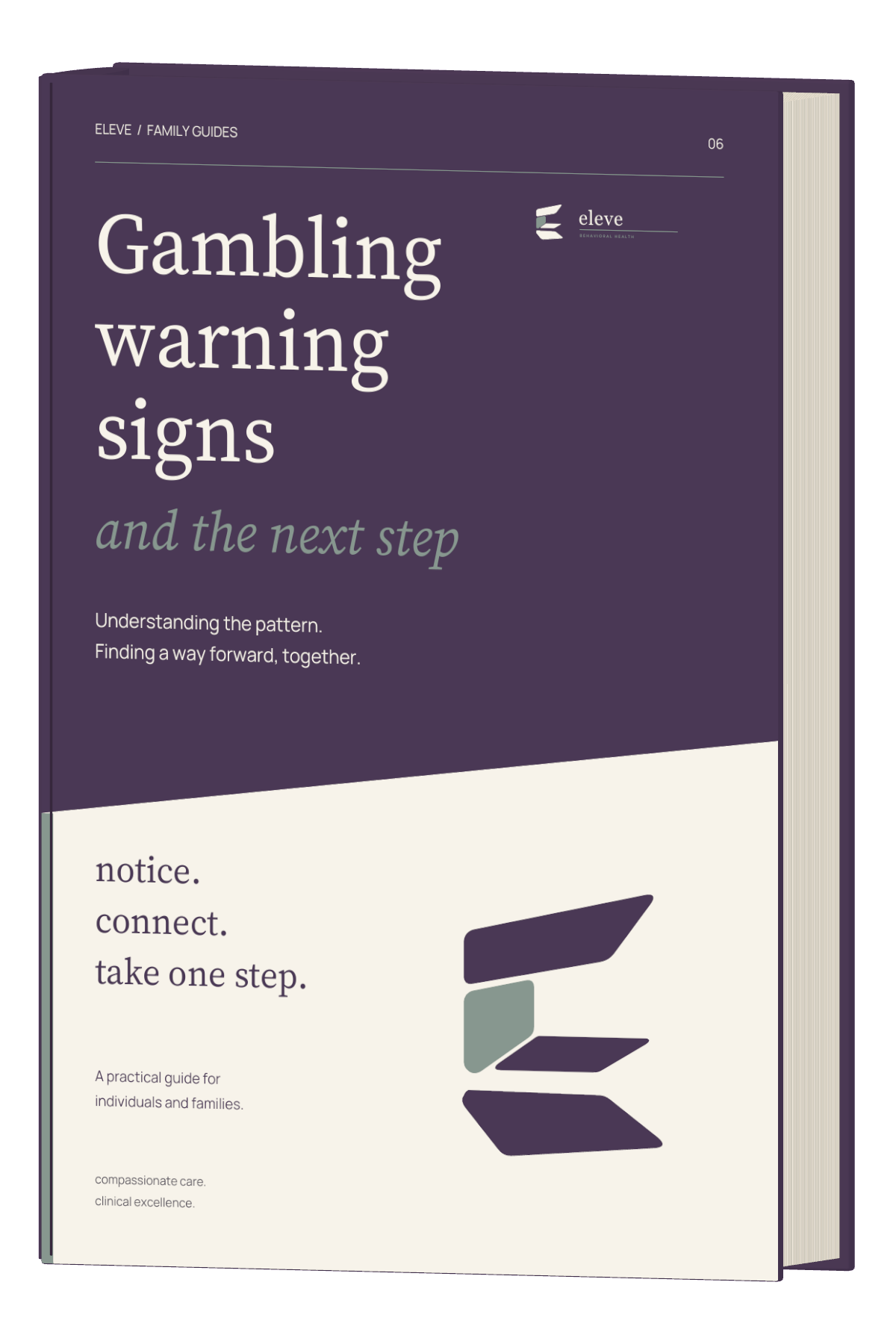
You do not need to have every answer. Our guide brings together gambling warning signs, supportive conversation prompts, and a practical next-step plan for you or someone you love.


07
problem gambling help
call or text admissions
(833) 348-9389immediate or crisis support
988Call 988, text 988, or chat at 988lifeline.org. If there is immediate danger or a medical emergency, call 911.
Eleve admissions
(833) 348-9389A private conversation about current treatment options, insurance verification, self-pay, and next steps.
independent state / national resources
- 1-800-MY-RESETnational resource
- NJ / PA 1-800-GAMBLER1-800-426-2537
- New York HOPEline1-877-8-HOPENY
- text HOPENYto 467369
988 and the state and national helplines are independent services. Contacting them does not begin an Eleve admission.
a private first step
Ask us to contact you.
Share only what Admissions needs to reach you. You do not need to explain the situation or provide clinical details here.
- Tell us the safest way to respond
- No commitment to treatment
- Call or text instead at (833) 348-9389
the Eleve Center for Gambling Recovery
A private conversation.
No commitment.
A family member may call. Admissions can discuss current program availability, insurance verification, self-pay, and what the next step could look like.