skip to content

Advice & FAQs

Start with the thing
you need to understand.

Practical guides, trusted perspectives, and clear answers for the questions that come with seeking care.

01 downloadable guides

a little clarity,
to take with you.

Six practical guides to help you prepare, ask better questions, and take the next step forward.

01 / 06 · insurance

Behavioral health insurance,
in plain English.

Understand benefits, out-of-pocket costs, authorization, claims, and the questions worth asking before care begins.


Behavioral health insurance, in plain English — Eleve guide cover

02 / 06 · before you arrive

Before the first call.
Before you arrive.

A useful place to begin: what to ask, what to have ready, and how to prepare for the first days of care.

Before the first call and before you arrive — Eleve guide cover

03 / 06 · family support

When someone
you love is in
treatment.

A practical companion for the days ahead: staying connected, offering useful support, and making room for your own wellbeing.

When someone you love is in treatment — Eleve guide cover

04 / 06 · warning signs

What to notice.
What to do next.

Recognize changes, have a calm conversation, and build a practical response before urgency takes over.

Relapse warning signs and next steps — Eleve guide cover

05 / 06 · choosing care

Ask the questions
that matter.

A clear way to compare treatment providers, understand clinical support, and keep the answers that help you decide.

How to evaluate a treatment provider — Eleve guide cover

06 / 06 · gambling warning signs

Gambling warning signs.
And the next step.

A grounded starting point for you or someone you love: changes to notice, a conversation to begin, and a practical plan for support.

4-page PDF · conversation prompts & planning worksheets
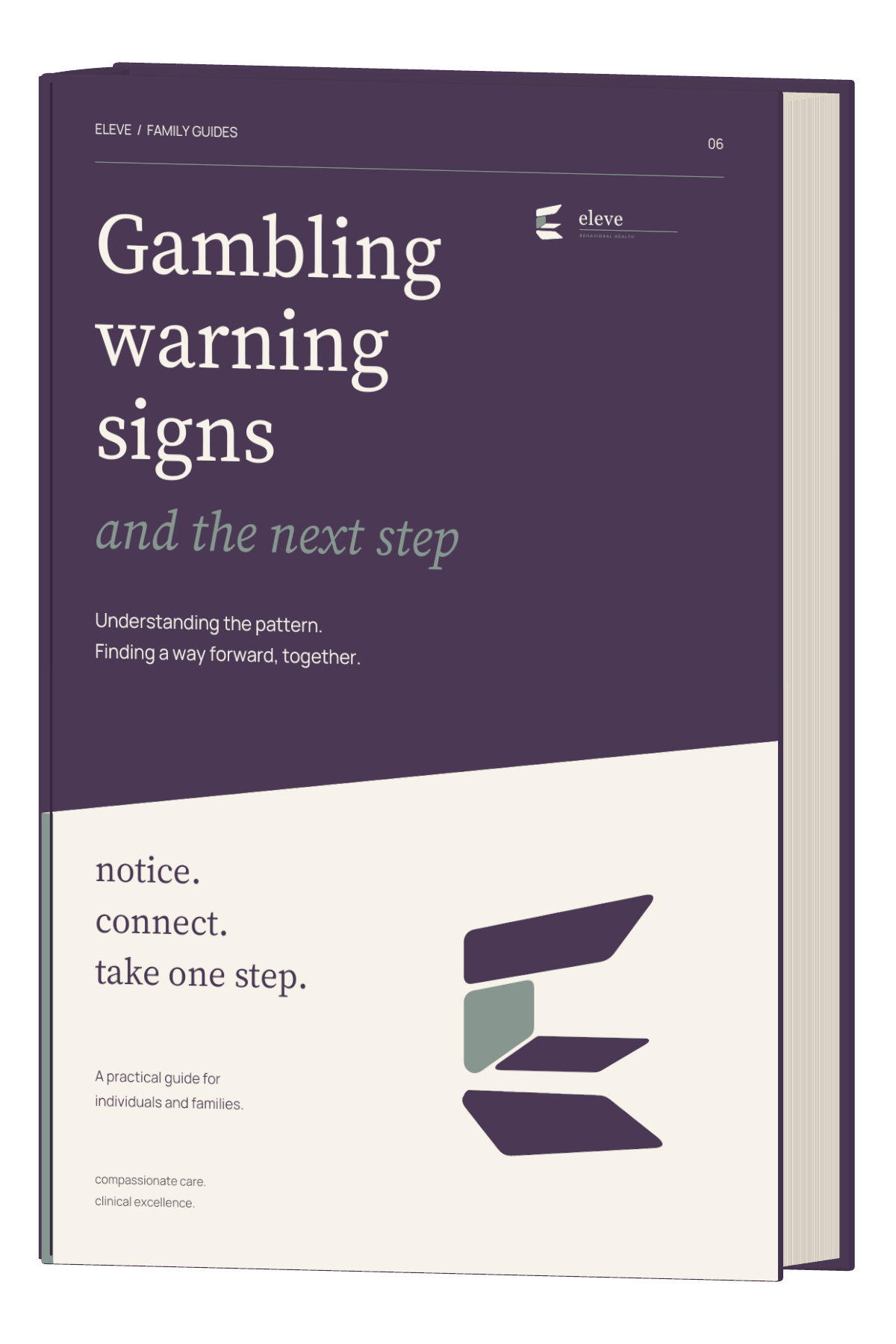
Gambling warning signs and the next step — Eleve guide cover
Eleve Behavioral Health

compassionate care.
clinical excellence.

03 a little more understanding

A place on
your bookshelf.

Perspectives on substance use, mental health, gambling, and the people we care about. Explore the collection at your own pace.

read

A little more understanding. At your own pace.

04

Before you choose

Questions to ask before you commit to a program.

Clarity is easier to compare than promises. Check each item only after you have a specific answer.

0of 10 answered clearly
Download the complete comparison guide
05

Plain English

The words between
you and a clear decision.

988
The Suicide & Crisis Lifeline. Call or text, free, 24/7.
1-800-GAMBLER
New Jersey's problem-gambling helpline, independent of Eleve and free 24/7.
Accreditation
An external review against defined quality and safety standards. It does not guarantee an individual outcome.
Abstinence
Choosing not to use a substance or engage in a behavior such as gambling. It is one possible treatment or recovery goal.
Acute risk
An immediate safety concern requiring prompt clinical, crisis, or emergency evaluation.
Admission
The formal entry into a program after clinical and practical requirements are completed and the service is determined to be appropriate.
Aftercare
The treatment, medication, appointments, peer support, and practical plan that continue after a program ends.
Allowed amount
The amount an insurance plan recognizes for a covered service. It may differ from the billed charge.
Appeal
A formal request that an insurer reconsider a coverage or payment decision.
Assessment
A structured review of symptoms, safety, functioning, history, supports, and treatment needs.
ASAM Criteria
A widely used framework for assessing needs and matching people to an appropriate addiction-treatment level of care.
Authorization
Plan approval for a service or level of care. It may be required before or during treatment.
Balance billing
When a provider bills a patient for the difference between a charge and the amount recognized by the plan, where permitted.
Behavioral health
A broad term covering mental health, substance use, behavior, and related emotional and functional needs.
Behavioral-health carve-out
When a health plan uses a separate organization to administer mental-health and substance-use benefits.
Biopsychosocial assessment
A review of biological, psychological, and social factors used to build the treatment plan.
Case management
Help coordinating practical barriers such as insurance, employment, transportation, legal needs, and continuing care.
CBT
Cognitive Behavioral Therapy, which works with patterns connecting thoughts, emotions, and actions.
Claim
A request sent to an insurer for payment or processing of a healthcare service.
Clinical documentation
The health record describing assessment, services, response, risk, decisions, and plans.
Clinical pre-screen
A focused conversation before admission used to identify immediate safety, withdrawal, symptom, medication, and level-of-care needs.
Clinical review
A review of current needs and progress used to confirm or adjust a level of care and treatment plan.
Co-occurring disorders
Substance use or gambling-related harm occurring alongside one or more mental-health conditions.
Coinsurance
The percentage of an allowed amount a patient may owe for a covered service.
Concurrent review
An insurer's review during treatment to decide whether to authorize additional time or services.
Consent
Permission for care or for a specific use or sharing of information. It should be informed and may have defined limits.
Continuity of care
Coordinating services, medications, information, and appointments so care does not break during a transition.
Coordination of benefits
The rules used to determine which insurance plan pays first when more than one plan may apply.
Copay
A fixed amount a plan may require for a covered visit or service.
CRAFT
Community Reinforcement and Family Training, an evidence-based approach that helps families support change and their own wellbeing.
Craving
A strong desire or urge to use a substance or engage in a behavior. Its intensity can change and can be addressed in treatment.
Crisis plan
A written plan for warning signs, contacts, medications, preferred supports, and emergency thresholds.
DBT
Dialectical Behavior Therapy, a skills-based treatment emphasizing emotion regulation, distress tolerance, mindfulness, and relationships.
Deductible
The amount a patient generally pays for covered services before the plan begins sharing eligible costs.
Detox
Medically supervised withdrawal. Eleve does not provide detox or inpatient beds.
Diagnosis
A clinical identification based on defined criteria and professional assessment, not a screening score alone.
Denial
An insurer's decision not to authorize or pay all or part of a service or claim. The reason and appeal rights should be available in writing.
Discharge plan
The documented next-care, medication, safety, support, and appointment plan for leaving a level of care.
Dual diagnosis
Another term for co-occurring substance-use and mental-health conditions.
EMDR
Eye Movement Desensitization and Reprocessing, a structured psychotherapy used for trauma-related symptoms.
EOB
An Explanation of Benefits showing how an insurer processed a claim. It is not itself a bill.
Evidence-based care
Care informed by research evidence, clinical expertise, and the person's needs and preferences.
External review
A review of an eligible insurance denial by an independent reviewer after applicable internal appeal steps.
Family therapy
Therapy that works with relationships, communication, roles, and patterns affecting a family system.
FMLA
The federal Family and Medical Leave Act. Eligibility and documentation requirements depend on the employee and employer.
Formulary
An insurance plan's list of covered medications and the rules or cost tiers that apply to them.
Functional health
A broad look at physical factors that may affect wellbeing, such as sleep, nutrition, labs, medications, and medical conditions.
Gamban
Device software designed to block access to many gambling sites and apps. It is a practical safeguard, not treatment by itself.
Group therapy
Clinical treatment facilitated with multiple participants, using shared discussion, practice, feedback, or education toward treatment goals.
Harm reduction
Strategies that reduce preventable injury, illness, or death while supporting movement toward broader health goals.
H&P
History and physical: a medical review of conditions, medications, symptoms, and relevant health history.
HIPAA
A federal health-privacy framework governing how covered entities use and disclose protected health information.
In network
A provider or service operating under contracted terms with an insurance plan or network.
Individual therapy
One-to-one psychotherapy between a client and a qualified clinician.
Inpatient care
Treatment in a hospital or facility where the patient stays overnight and receives around-the-clock care.
Intake
The information, paperwork, consent, orientation, and initial clinical steps completed when entering care.
Intoxication
Impairment or physical and mental effects caused by a substance currently in the body.
IOP
Intensive Outpatient Program: structured treatment with fewer weekly clinical hours than PHP.
Level of care
The intensity and structure of treatment recommended by clinical assessment and reviewed over time.
Licensed clinician
A professional authorized by a state licensing board to provide defined clinical services within the scope of that license.
MAT
Medication-assisted treatment: medication used with counseling and other supports when clinically appropriate.
Medical necessity
Criteria an insurer or clinician uses to determine whether a service or level of care is clinically indicated.
Measurement-based care
Using repeated, appropriate measures alongside clinical judgment and the person's experience to track change and guide decisions.
Medication management
Evaluation, prescribing, monitoring, and adjustment of medication by a qualified prescriber.
Mental-health parity
Rules that generally restrict many health plans from applying more limiting financial requirements or treatment limits to mental-health and substance-use benefits than to medical and surgical benefits.
MOUD
Medications for opioid use disorder, such as buprenorphine, methadone, or naltrexone, used when clinically appropriate.
Motivational interviewing
A collaborative approach that helps a person explore ambivalence and their own reasons for change.
Naloxone
A medication that can temporarily reverse an opioid overdose. Emergency help is still required.
Network adequacy
Whether a health plan's provider network offers reasonable access to covered services. Standards and remedies vary.
Network exception
An insurer-approved arrangement that may allow out-of-network care to be treated differently when appropriate in-network access is unavailable.
OP
Outpatient care, often lower intensity and longer term than PHP or IOP.
Overdose
A medical emergency caused by a toxic amount or combination of substances. Call 911 for suspected overdose.
Out of network
A provider or service without contracted in-network terms for the plan being used.
Out-of-pocket maximum
The plan-year ceiling for certain covered in-network patient costs. Premiums and non-covered charges usually do not count.
PHP
Partial Hospitalization Program: the most structured level of outpatient treatment.
Pharmacogenetic testing
Information about how genetic variation may affect medication metabolism. It supports, but does not replace, prescriber judgment.
Peer recovery support
Non-clinical support provided by someone using relevant lived experience and training to support recovery goals and connection.
Person-centered care
Care organized around the individual's needs, goals, culture, preferences, strengths, and informed choices.
Prior authorization
Insurer approval that may be required before a service or level of care begins.
Premium
The amount paid to maintain insurance coverage. Premiums generally do not count toward an out-of-pocket maximum.
Problem gambling
Gambling that is causing harm or concern, whether or not a formal diagnosis has been made.
Protected health information
Individually identifiable health information protected under applicable privacy rules when held or transmitted by a covered entity or business associate.
Psychiatric evaluation
A medical assessment of mental-health symptoms, history, safety, functioning, diagnosis, and possible treatment including medication.
Psychiatry
Medical evaluation and treatment of mental-health conditions, including medication when appropriate.
Psychotherapy
Structured treatment using psychological methods to work with symptoms, behavior, relationships, and functioning.
Recovery support
Peer, community, family, housing, vocational, and practical supports that help recovery continue outside clinical sessions.
Recovery capital
The personal, social, community, and practical resources that can support change and sustained recovery.
Recovery residence
A substance-free living setting designed to support recovery. Services, staffing, licensure, and clinical connections vary by residence.
Remission
A period when a condition's symptoms no longer meet full diagnostic criteria or are substantially reduced, as defined clinically.
Residential treatment
A live-in, non-hospital treatment setting offering structured care and support around the clock.
Return to use
A return to substance use or gambling after a period of change or recovery. It is a signal to assess safety and revise support, not a moral failure.
Return-to-use plan
A specific plan for early warning signs, contacts, safety steps, and clinical reassessment if substance use or gambling returns.
REMS
A Risk Evaluation and Mitigation Strategy required by the FDA for certain medications or settings.
ROI
A Release of Information authorizing specific health information to be shared with specific people or organizations.
Screening
A brief tool estimating whether more assessment may be useful. It does not create a diagnosis by itself.
Safety plan
A written, personalized set of warning signs, coping steps, people and services to contact, and ways to reduce immediate risk.
SBIRT
Screening, Brief Intervention, and Referral to Treatment: a public-health approach for identifying risk and connecting people to care.
Self-exclusion
A voluntary process used to restrict one's own access to specified gambling venues or platforms. It is a safeguard, not treatment by itself.
Single-case agreement
A one-time agreement between an insurer and provider setting terms for a specific member's care.
Summary of Benefits and Coverage
A standardized overview of a health plan's benefits, cost sharing, limitations, and coverage examples.
Summary Plan Description
A document describing the rights, benefits, exclusions, claims, and appeal rules of many employer-sponsored plans.
Step-down
A planned move to a lower-intensity level as stability and functioning improve.
SUD
Substance use disorder, a clinical diagnosis involving a problematic pattern of alcohol or drug use.
Supportive housing
Housing paired with practical structure or support. It is distinct from the licensed clinical treatment delivered by a healthcare program.
Trauma-informed care
An approach that recognizes trauma's possible effects and emphasizes safety, trust, collaboration, choice, and avoiding unnecessary retraumatization.
Treatment plan
The individualized goals, services, responsibilities, and review points guiding care.
Utilization review
Clinical and insurance review used to evaluate authorization or continued stay at a level of care.
Verification of benefits
A review of available plan information. It is not a guarantee of payment, authorization, or final patient responsibility.
Withdrawal
Physical or psychological symptoms that can occur when a substance is reduced or stopped. Some withdrawal can be life-threatening and needs medical care.
Withdrawal management
Clinical assessment, monitoring, medication, and support used to manage withdrawal safely; often called detox.

Definitions stay tucked away until you search or choose a letter.

06

Straight answers

The questions underneath
the first question.

Start with the subject that matters now, or choose whether you are looking for yourself, someone you love, or someone you are referring. Open only the answers you need.

30 answersfor everyone, across every topic
01What happens on the first call?

Tell us what is happening. Admissions listens, asks about immediate safety, explains Eleve’s current program, and outlines the next appropriate step.

See the admissions sequence
02Can admission happen the same day?

It may be possible when the clinical pre-screen, insurance or payment review, required records, medication review, transportation, and scheduling can all be completed safely. Same-day admission is never guaranteed.

03What if I am not sure there is a problem?

That uncertainty is a reasonable reason to call. An initial conversation can help separate a difficult period from a pattern that may need clinical attention. A recommendation may also be that Eleve is not the right next step.

04How is the right level of care decided?

A clinician considers safety, withdrawal risk, symptoms, daily functioning, supports, and what has or has not worked before. The recommendation should follow the assessment - not a preference selected from a menu.

05What happens when I arrive?

You are welcomed, oriented to the space and schedule, and helped through the first practical steps. With consent, a safety call can let a chosen family member know you arrived. The full assessment and treatment plan develop over the first days rather than landing all at once.

See what treatment feels like
06Can Eleve admit someone for primary mental-health treatment?

Not yet. Eleve currently admits adults for substance use disorders and gambling-related harm, including co-occurring anxiety, depression, trauma, and other mental-health needs. Primary mental-health-only admission remains unavailable while the applicable New Jersey license is pending.

07Does Eleve accept insurance?

Eleve works with many major insurance plans. Admissions verifies available benefits, confirms the network position being used, and explains the available estimate before treatment begins. Verification is not a guarantee of payment or authorization.

Verify your benefits
08Will I know the estimated cost before I start?

Admissions explains the available insurance estimate or private-pay structure before admission. Ask for the network status, deductible, coinsurance, out-of-pocket position, authorization requirements, and what could change the estimate.

Download the insurance guide
09What do deductible, coinsurance, and out-of-pocket maximum mean?

The deductible is generally what you pay before the plan begins sharing eligible costs. Coinsurance is a percentage of the plan's allowed amount. The out-of-pocket maximum is a plan-year ceiling for certain covered in-network costs. Every plan applies these terms differently.

10What changes when a provider is out of network?

Out-of-network benefits can use a separate deductible, coinsurance, allowed amount, and out-of-pocket maximum. Ask whether balance billing could apply and exactly which amount the estimate uses.

11What if insurance does not cover enough?

Say that directly on the first call. Admissions can explain available private-pay or payment options and help identify other appropriate resources when Eleve is financially out of reach.

12What is the difference between PHP, IOP, and outpatient care?

They are different intensities of outpatient treatment. PHP is the most structured daytime level, IOP provides fewer weekly clinical hours, and ongoing outpatient care is lighter and longer term. The recommendation and schedule are individualized and confirmed by Admissions.

13How long does treatment last?

There is no honest universal number. Duration depends on clinical need, progress, attendance, the starting level of care, insurance authorization, and the stability of the plan outside treatment. The goal is a supported step-down, not an abrupt stop.

Length of stay varies based on your needs, progress, and clinical recommendations. Most clients participate in a combination of PHP, IOP, and OP over several weeks to build real, lasting change.

14What conditions can Eleve currently admit?

Eleve currently admits adults for substance use disorders and gambling-related harm, including co-occurring mental-health needs. Primary mental-health-only admission is pending New Jersey licensure.

15Does Eleve provide detox or inpatient treatment?

No. Eleve is outpatient and does not provide medically supervised withdrawal or inpatient beds. When detox or another level must come first, Admissions helps coordinate the handoff.

16Is medication-assisted treatment available?

Medication options may be included when a qualified prescriber determines they are appropriate. Medication is one part of a broader plan that may include therapy, monitoring, case management, wellness, and recovery support.

17Are therapy, psychiatry, and case management coordinated?

They are intended to work from one treatment plan rather than as disconnected services. Your exact team and cadence depend on the clinical assessment and level of care.

18How does Eleve look at physical and functional health?

When clinically indicated and available within the program, medical evaluation may include laboratory review and pharmacogenetic information to support prescribing decisions. These tools inform a licensed clinician; they do not diagnose a condition or choose a medication on their own.

19Can clients keep their phones, tablets, and laptops?

Eleve is a technology-friendly outpatient program. Clients generally retain access to devices. Individual safety needs and gambling-related safeguards, including blocking software when appropriate, may change how a device is used and are explained directly.

20Will my employer find out?

Not from Eleve without your written authorization. Treatment information is protected. Case management can help with appropriate leave or return-to-work paperwork without requiring you to disclose more than the process requires.

21Who can Eleve speak with about treatment?

For an adult client, only the people and information covered by valid consent. Consent can be specific and can change. Families may provide information even when the program cannot confirm or discuss care in return.

22Can I keep working or attending school?

Many clients do, especially at lower-intensity outpatient levels. The workable schedule depends on clinical need, program availability, transportation, and the commitments you are balancing.

23How are families involved?

With the client's consent, family involvement may include education, counseling, communication planning, and discharge preparation. The goal is useful participation, not turning a family member into the treatment monitor.

Visit Family & Friends
24Can I call if my loved one is not ready?

Yes. Admissions can explain what is possible, what requires the person's participation, and which family-support approaches may help without pretending anyone can force readiness.

25How do I know when this is an emergency?

Call 911 for immediate danger, suspected overdose, loss of consciousness, severe breathing problems, or imminent harm. Call or text 988 for suicide or mental-health crisis support. Eleve is not a crisis service.

26Does Eleve provide supportive housing?

Housing may be coordinated through our partner organization under a separate housing agreement. Eligibility, availability, rules, and the $1,500 monthly housing fee are explained before anyone commits.

See what housing includes
27Where is Eleve and can Admissions help with transportation?

Eleve is at 1307 White Horse Road, Suite A103, Voorhees Township, New Jersey. If transportation is a barrier, raise it during Admissions so available options can be discussed before the start date.

Directions and arrival information
28What should I bring on the first day?

Admissions confirms the exact list. It commonly includes photo identification, insurance information, current medications, and relevant records you already have. Do not delay a needed call because you do not have every document.

Use the admissions checklist
29How does a professional referral work?

Call Admissions with the relevant clinical picture. With appropriate authorization, records can be reviewed and a disposition update can be shared. A dedicated professional-referral page will provide the secure workflow and direct contacts.

30Can our organization schedule a tour or presentation?

Yes. Professionals can request a facility tour, clinical overview, or an in-service presentation for their organization through the dedicated referral-relations contact route.